
شاشة عرض مغناطيسية لصور السيلفي
وفر 24%! اشترِ شاشة عرض مغناطيسية لصور السيلفي بسعر 412.8 د.ل فقط في ليبيا. متوف
🛒 تسوق الآن Libya Press
US President Donald Trump's Senior Adviser for Arab and African Affairs, Massad Boulos, has reaffirmed the United States' commitment to working with international partners to promote peace and stability in Libya, according to statements published by Libyan media on July 10, 2026.
In a series of engagements across Libya, Boulos emphasized Washington's unwavering support for a Libyan-led political process under the auspices of the United Nations, highlighting the importance of unifying national institutions and preserving Libya's sovereignty.
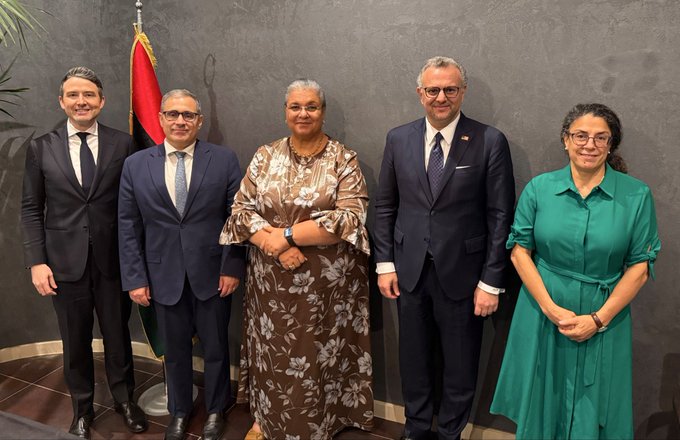
Boulos met with the UN Special Representative for Libya, Hanna Tetteh, and her deputy Stephanie Khoury, where both sides discussed joint efforts to advance the political track in Libya. The meeting focused on strengthening cooperation between the United States and the United Nations Support Mission in Libya (UNSMIL) to achieve tangible progress on the ground.
The US adviser expressed his appreciation for the continuous UN efforts to facilitate dialogue among Libyan parties, describing the discussions as "productive." Boulos reiterated Washington's full backing of UNSMIL's roadmap under Tetteh's leadership, according to a statement from the Libyan News Agency (LANA).
Addressing concerns about overlapping international initiatives, Boulos clarified that the American initiative in Libya is "a short-term effort designed to fully complement the UN-led roadmap." This statement aimed to reassure Libyan stakeholders that Washington's engagement is not intended to bypass the UN framework but rather to accelerate progress toward a political resolution.
The US initiative, announced by Boulos on June 17, 2026, has been described as a project to re-engineer the balance of power within Libya's political landscape. Critics have raised questions about its scope, but Boulos maintains it aligns with the broader international consensus on Libyan-led reconciliation.
During his visit to Misrata on July 7, Boulos met with municipal leaders and discussed support for Libyan consensus-building to pave the way for successful elections. The US adviser emphasized that inclusive dialogue remains the cornerstone of any lasting political settlement in Libya.
"We discussed supporting Libyan consensus to hold successful elections," Boulos said following his meeting with Misrata's municipal council. The discussions also covered economic stability, with Boulos separately meeting Finance and Economy Minister Naji Issa on July 7 to review the financial and economic situation in the country.
Boulos has repeatedly stressed that stability in Libya requires strong, professional institutions capable of serving all Libyans. In several statements this year, he called for unifying institutions and restoring economic vitality through an inclusive political process.
In his April 2026 meeting with Tetteh, Boulos stated: "I appreciate the continuous UN efforts to facilitate Libyan-led dialogue and promote national reconciliation." The message was consistent with Washington's long-standing position that a unified Libya with sovereign institutions is the only path to sustainable peace.
The United States has intensified its diplomatic engagement with Libya in 2026, with Boulos shuttling between Libyan factions and regional capitals including Rome and Paris to build support for the political process. Reports indicate that Pakistan has also sought to help broker discussions, with Islamabad viewing its ties to eastern Libya as a potential bridge for advancing the initiative.
However, challenges remain. Analysts note that neither side in Libya's fragmented political landscape fully trusts power-sharing arrangements, and the path to unified governance remains uncertain. Boulos acknowledged these difficulties but reiterated that dialogue — not military solutions — remains the only viable path forward.
With the UN-led process continuing and the US actively supporting it, the coming weeks will be crucial for determining whether Libya's rival factions can seize the opportunity for genuine reconciliation and lasting peace.
— Libya Press / Politics Desk