
شاشة سيارة لاسلكية
وفر 27%! اشترِ شاشة سيارة لاسلكية بسعر 1065.6 د.ل فقط في ليبيا. متوفر حالياً، ال
🛒 تسوق الآن Libya Press
Canada, spanning the northern two-fifths of North America, is the second-largest country in the world by total area at approximately 9.98 million square kilometres. Despite its vast size, it remains one of the most sparsely populated nations, with a population density of under 4 people per square kilometre. The country stretches from the Atlantic Ocean to the Pacific Ocean and northward into the Arctic Ocean, giving it the longest coastline of any nation on Earth.
Indigenous peoples, including First Nations, Inuit, and Métis, inhabited Canada for thousands of years before European arrival. Norse explorers reached Newfoundland around 1000 AD, but sustained European contact began in the late 15th and early 16th centuries. France established the colony of New France in the 1600s along the St. Lawrence River. Following the Seven Years' War, Britain gained control under the Treaty of Paris in 1763. The British North America Act of 1867 united several colonies into a federal dominion, marking the birth of modern Canada, which achieved full sovereignty with the Constitution Act of 1982.
Canada's population surpassed 40 million in 2024, making it the 36th most populous country worldwide. More than 80 per cent of Canadians live in cities, with the largest metropolitan areas being Toronto (over 6 million), Montreal (over 4 million), Vancouver (over 2.6 million), and the capital region of Ottawa-Gatineau (over 1.4 million).
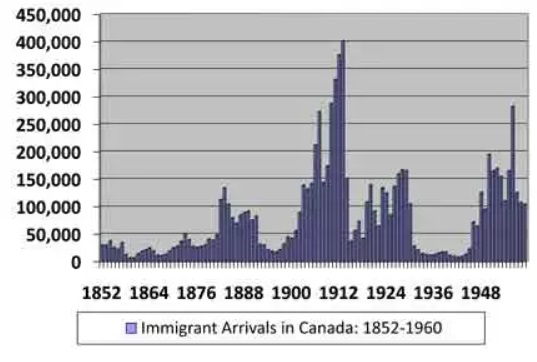
Immigration drives roughly 75 per cent of Canada's annual population growth, as the fertility rate of 1.4 children per woman remains well below the replacement level of 2.1. The median age of approximately 41 years reflects an aging population that increasingly relies on newcomers to sustain the labour force and social services.
Canada is widely regarded as one of the world's most immigration-friendly nations. In 2025, the country targeted approximately 485,000 new permanent residents annually. The immigration system operates through several streams: economic immigration (skilled workers and business immigrants, roughly 60 per cent of admissions), family reunification (about 25 per cent), and refugee and humanitarian programmes (around 15 per cent).
The points-based Express Entry system ranks candidates by age, education, work experience, and language proficiency. The Provincial Nominee Programme allows provinces to nominate immigrants meeting regional labour needs. Canada has also expanded pathways for temporary foreign workers and international students to transition to permanent residence.
Ottawa, located in Ontario on the Ottawa River bordering Quebec, was selected as Canada's capital by Queen Victoria in 1857. The city houses Parliament Hill, the official residences of the Prime Minister and Governor General, and the Supreme Court of Canada. Ottawa's metropolitan population exceeds 1.4 million, making it the fourth-largest urban area in the country. It is a bilingual city with both English and French as official languages and hosts national institutions including the National Gallery of Canada and the Canadian Museum of History.
Canada's official currency is the Canadian dollar (symbol: $; code: CAD), introduced in 1858 to replace the Canadian pound. The Bank of Canada, established in 1934, manages monetary policy and issues polymer banknotes known for their durability. The Canadian dollar ranks among the world's top ten most traded currencies and is considered a "commodity currency" because its value is influenced by global prices of crude oil, minerals, and timber—key Canadian exports. As of mid-2026, the exchange rate hovers around 1.36 CAD per US dollar.
Canada shares the world's longest international land border with the United States, stretching approximately 8,891 kilometres. The country is a leading producer of potash, uranium, nickel, and timber, and holds the third-largest proven oil reserves globally, primarily in the Alberta oil sands. As a member of the G7, NATO, the Commonwealth, and the OECD, Canada plays an active role in global affairs. Its economy, valued at over 2.1 trillion US dollars, is highly diversified across services, manufacturing, natural resources, and technology sectors.
— Libya Press / International Desk