
صندوق غداء حراري مع حقيبة محمولة
وفر 24%! اشترِ صندوق غداء حراري مع حقيبة محمولة بسعر 298 د.ل فقط في ليبيا. متوفر
🛒 تسوق الآن Libya Press
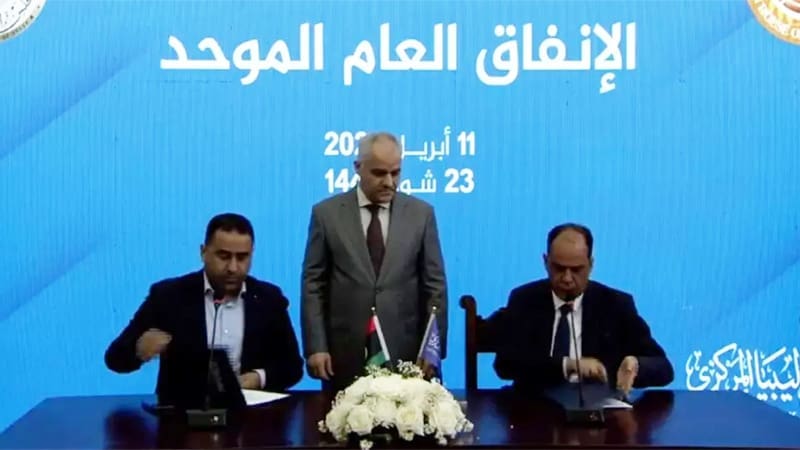
More than a decade after the fall of Moammar Gadhafi's regime, Libya remains deeply divided between two rival power centers. The internationally recognized Government of National Unity (GNU) under Prime Minister Abdul Hamid Dbeibeh controls Tripoli and the west, while General Khalifa Haftar's Libyan Arab Armed Forces (LAAF) dominates the east and south, controlling roughly 60 percent of the nation's territory including its vast oil reserves. Reunifying the country demands confronting entrenched militia power, foreign interference, and collapsed state institutions.
Libya's split is institutional as well as geographic. Haftar has established parallel versions of every major state body — the Central Bank, the National Oil Corporation, and the House of Representatives — in his eastern stronghold of Benghazi. In Tripoli, power is shared uneasily between the GNU and armed factions including the Deterrence Apparatus for Combating Organized Crime and Terrorism (DACOT, also known as the Special Deterrence Force or Rada), the Stability Support Authority, and the 444 Brigade. These militias entrench fragility rather than providing security. Between 2008 and 2024, over 1.5 million of Libya's 7.1 million people were internally displaced by violence, and more than 100,000 remain displaced today.
Russia and Turkey have turned Libya into a proxy arena. After the fall of the Assad regime in Syria, Moscow refocused on Libya, stationing troops and military hardware in the east where Haftar benefits from Russian support. Turkey, meanwhile, has positioned itself militarily and economically in western Libya, seeking to expand its Mediterranean influence. European powers add further complexity: France and Italy compete over migration, counterterrorism, and energy interests. Analysts at the New Lines Institute argue that the United States must act strategically to prevent Russia and Turkey from dictating Libya's future, warning that unchecked foreign meddling threatens NATO cohesion and global energy security. U.S. oil companies including ConocoPhillips maintain significant interests in Libyan concessions, giving Washington both economic and strategic stakes in stabilization.
Experts recommend a transitional political framework built on inclusive, democratically elected leadership that represents all Libyan factions. The New Lines Institute proposes focusing U.S. policy on local institution-building rather than national-level negotiations, using public benchmarks to incentivize both governments to reduce reliance on foreign backing. NATO Intelligence, Surveillance, and Reconnaissance support could help local authorities organize unified elections. The path is narrow: corruption is deeply entrenched, armed Islamist groups including remnants of ISIS and Ansar al-Sharia still operate in central and eastern desert regions, and Libya's elites benefit from the status quo. Yet if the international community can help the rival governments find common ground on security and governance, lasting peace remains a real possibility.
Libya's reunification will not happen overnight. It requires sustained international commitment, genuine political will from Libyan leaders on both sides, and a security framework that replaces militias with accountable institutions. The cost of inaction — a permanently fractured state at the heart of the Mediterranean — is far greater than the investment required to build a unified Libya.