
شاشة عرض مغناطيسية لصور السيلفي
وفر 26%! اشترِ شاشة عرض مغناطيسية لصور السيلفي بسعر 399 د.ل فقط في ليبيا. متوفر
🛒 تسوق الآن Libya Press
TRIPOLI, Libya — June 4, 2026 — The fifth edition of the Libya Energy & Economic Summit (LEES) will return to Tripoli on January 23–25, 2027, positioning itself as the country's premier international platform for energy investment, technical collaboration, and private sector engagement across oil, gas, power, and renewables.
The announcement comes as Libya's energy sector transitions from post-recovery stabilization to what organizers describe as "execution-led development" — a pivot from ambition to delivery that has attracted billions in projected investment and renewed international interest in the country's vast hydrocarbon reserves.
LEES 2026 established an estimated $18 billion pipeline of energy and infrastructure projects, signaling strong investor confidence in Libya's trajectory despite years of political instability. The 2027 summit intends to assess early results from that pipeline and accelerate project timelines across the upstream, midstream, and downstream sectors.
"The 2026 edition repositioned the sector from ambition to delivery," organizers stated, "and LEES 2027 will set the foundation for an execution-focused agenda."
A central pillar of the energy push is the National Oil Corporation's landmark 2026 licensing round, which introduced 22 onshore and offshore exploration blocks — Libya's first such offering in 17 years. Alongside the licensing round, the NOC has mandated drilling 70 to 100 new wells annually to boost production capacity.
LEES 2027 will evaluate initial seismic results from these blocks, track contract awards to international oil companies, and assess the critical transition from exploration rights into full operational development phases.
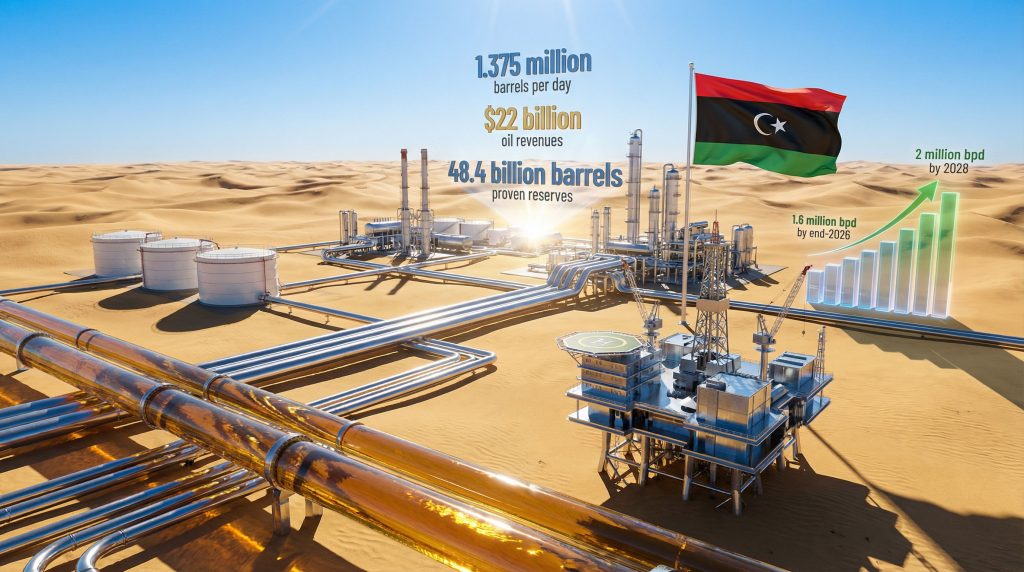
Libya's oil output has stabilized at approximately 1.4 million barrels per day (bpd) throughout 2026, a significant recovery from the sub-900,000 bpd levels seen during peak conflict years. The summit will chart pathways toward 1.6 million bpd in the near term, with a long-term ambition of reaching 2 million bpd.
Directly endorsed by the NOC, LEES 2027 will focus on resolving infrastructure bottlenecks, optimizing existing field production, and expanding midstream capacity required to support higher output levels. The session will bring together operators, service companies, and government officials to align on technical and regulatory priorities.
International energy giant Eni's $8 billion offshore Structures A&E project remains on track for completion by late 2027, representing one of the single largest foreign investments in Libya's modern energy history. The project is expected to significantly boost Libya's gas processing and export capacity.
Meanwhile, discussions around Chevron-linked shale studies highlight potential resources estimated at 123 trillion cubic feet of gas and 18 billion barrels of oil across key basins, including Sirte, Murzuq, and Ghadames — resources that could reshape Libya's energy landscape for decades.
Beyond hydrocarbons, Libya's 4 GW solar roadmap is advancing. French major TotalEnergies is anchoring the push with its 500 MW Sadada solar project, supported by the Renewable Energy Authority of Libya. LEES 2027 is expected to showcase financial close milestones, construction timelines, and the scaling of independent power purchase structures within the national grid strategy.
The Energy JEEL initiative has trained more than 900 Libyan youth aged 15–35 in engineering, digital systems, and energy operations, forming a national talent pipeline aligned with the country's long-term energy transition and industrial expansion goals.
The sector aims to attract an estimated $3–4 billion in annual drilling investment following unified drilling regulations announced in 2026. LEES 2027 will assess early implementation outcomes, focusing on operational safety, fiscal predictability, and contract execution efficiency.
Against this backdrop, the summit — taking place at the Tripoli International Convention Center — will serve as the sector's execution benchmark, seeking to convert licensing frameworks and infrastructure commitments into tangible production growth and economic diversification.
— LibyaPress / Energy & Economy Desk