
شاشة عرض مغناطيسية لصور السيلفي
وفر 26%! اشترِ شاشة عرض مغناطيسية لصور السيلفي بسعر 399 د.ل فقط في ليبيا. متوفر
🛒 تسوق الآن Libya Press
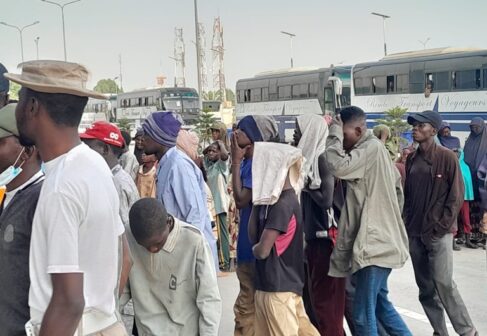
On Sunday, May 24, 2026, 329 stranded Nigerians arrived at Malam Aminu Kano International Airport after enduring life-threatening conditions in Libya — a harrowing experience that has become all too common for those seeking better opportunities abroad.
The returnees, arriving aboard six luxury buses, were repatriated through a voluntary program coordinated by Nigeria’s Ministry of Foreign Affairs, the Nigerian Mission in Niger Republic, and the International Organisation for Migration (IOM).
Dr Nura Abdullahi, Head of Operations at NEMA Kano Office, confirmed the returnees underwent physical verification and profiling upon arrival.
He emphasized that the repatriation was voluntary — not a forced evacuation — and explained that after initial medical screening, the returnees would be transported back to their respective states of origin: Kaduna, Jigawa, Kano, Borno, and Katsina.
“The programme was meant to ensure the safe and dignified return of stranded Nigerians,” Abdullahi stated, underscoring the tripartite arrangement involving IOM and the Federal Government.
One returnee, Mrs Fatima Sani, a widow and mother of five from Nasarawa Local Government Area of Kano State, shared her harrowing experience.
“My husband died two years ago, leaving me with five children. We had no food to eat and could not pay our house rent. That was why I travelled to Libya to make money to pay my rent and start a business,” she said.
Sani, who worked as a househelp in Libya, added: “Life was not easy in Libya. I worked as a house help in Libya, doing chores such as sweeping and washing dishes.” She was later attacked by thieves who stole her money.
For Libyans, this story underscores the dangerous transit point Libya has become for irregular migration — a reality that contributes to instability, human trafficking networks, and reputational damage.
Libya remains a key departure point for migrants attempting to cross the Mediterranean, but for many like Sani and fellow returnees, the journey ends not in Europe, but in danger, detention, and forced return — often with nothing but trauma and debt.
The Libyan conflict and fragmentation have created a power vacuum exploited by smuggling networks, turning the country into a pipeline for desperate people — many of whom, like these Nigerians, suffer abuse, exploitation, and violence.
Saihatu Idris, another returnee, urged the Nigerian government to provide business grants to help rebuild their lives: “I now realise Nigeria is safer,” she said, urging fellow youths to avoid the perilous journey.
Dr Nura Abdullahi echoed this sentiment, advising Nigerians: “Look beyond seeking better livelihoods outside the country and avoid endangering their lives through irregular migration.”
The returnees’ appeal — for grants, support, and sensitization — offers a sobering reminder that sustainable solutions lie not in migration, but in domestic opportunity and national security.