
سماعات الاذن
وفر 24%! اشترِ سماعات الاذن بسعر 290 د.ل فقط في ليبيا. متوفر حالياً، الدفع عند ا
🛒 تسوق الآن Libya Press
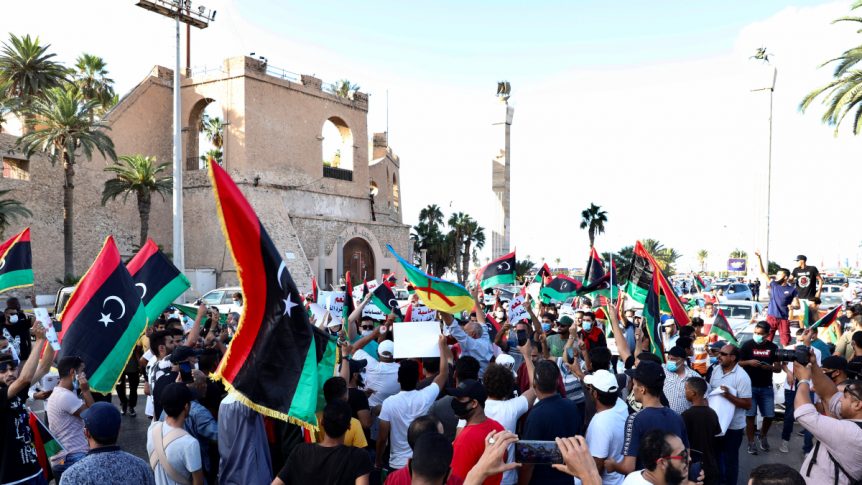
On June 8, 2026, nine Libyan municipalities jointly announced the formation of a new administrative entity called the "Central Region" — igniting protests, political division, and legal controversy across the country. The announcement, made at a press conference in Misrata, marks the most significant attempt at administrative reorganization in Libya since the federal system was abolished in 1963. Critics warn the move risks deepening territorial fragmentation, while supporters say it addresses long-neglected development needs.
The nine municipalities — Misrata, Bani Walid, Tamininay, Al-Mardoum, Zliten, Al-Khoms, Tarhunah, Qasr Al-Akhiyar, and Msallata — signed a joint declaration establishing the "Central Region" as a framework for coordination and joint cooperation. Led by Tarhunah mayor Muhammad Al-Kashar, the mayors stated the initiative aims to unify development efforts, improve public services, and achieve balanced growth across Libya's densely populated central corridor.
The declaration emphasized the entity is "not merely an organizational announcement, but a step toward a more coordinated and integrated future." The mayors framed it as a response to local residents' demands. Libya's central region is one of the country's most densely populated areas, where citizens have long complained of inadequate infrastructure and service delivery.
Professor Khalifa Ahwas, a constitutional law lecturer at the University of Sirte, declared the announcement "legally void and without any constitutional or legal basis." Speaking to Libya Al-Hadeth TV, Ahwas stressed that administrative regions have no standing in Libya's current legislative framework, which operates on a municipality-based system.
"The announcement came as a surprise to Libyan citizens, but it amounts to nothing — legally, it is equivalent to non-existence," Ahwas said. He warned the timing suggests political motivations, possibly aimed at "reshuffling the cards" in Libya's fractured political landscape. While Law No. 59 of 2012 permits development regions among adjacent municipalities, Ahwas confirmed the announced entity does not fall within that legal framework.
The announcement has sharply divided Libya's political communities. Some view it as a pragmatic response to governance gaps that Tripoli's central government has failed to address for over a decade. Others see it as a dangerous precedent accelerating Libya's disintegration into competing territorial fiefdoms.
Not all central region municipalities joined the declaration — several publicly declined, citing legal concerns. Professor Ahwas noted that even unanimous municipal agreement would not confer legal legitimacy, as constitutional authority to reorganize boundaries rests exclusively with the House of Representatives. Activist Mabrouk Al-Suwayh warned the "fourth region" idea surfaces whenever Libya enters political deadlock, cautioning against partition risks.
The controversy strikes at Libya's fundamental governance question: how should power be distributed across a country divided between rival administrations since 2014? For ordinary Libyans in the central region, the debate is less about constitutional theory and more about daily realities — unreliable electricity, deteriorating roads, and inadequate healthcare. Without legal recognition from the House of Representatives, the Central Region remains an aspirational framework with no binding authority over state institutions or budgets.
The coming days will determine whether the declaration gains political traction or fades as a symbolic gesture. The House of Representatives has yet to respond officially, and the Government of National Unity has remained largely silent. International observers, including the United Nations Support Mission in Libya, are monitoring closely, as any unilateral restructuring could complicate ongoing efforts to unify Libya's institutions ahead of planned elections.
— LibyaPress / Libya Desk