
طقم أدوات كهربائية بقوة 48 فولت
وفر 23%! اشترِ طقم أدوات كهربائية بقوة 48 فولت بسعر 549 د.ل فقط في ليبيا. متوفر
🛒 تسوق الآن Libya Press
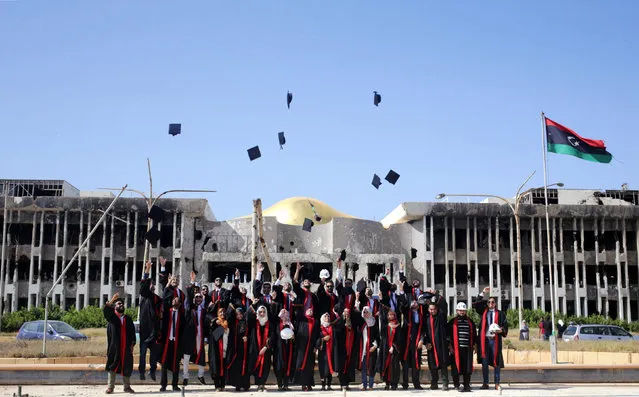
Benghazi, Libya — June 12, 2026. Nearly 70,000 students at Libya's oldest and largest university are preparing to move into a brand-new 600-hectare campus this autumn, marking a dramatic turning point for an institution once reduced to rubble by years of civil conflict. The University of Benghazi, founded in 1955, endured some of the fiercest fighting in Libya's post-2011 chaos — but today, its students are dreaming again.
Between 2014 and 2016, jihadist groups that controlled Benghazi turned the university grounds into a warzone. University president Ezzedin Younis Eddressi said militants "had planted artisanal mines almost everywhere" on campus. Approximately 90 percent of the complex was destroyed, and manuscripts dating back 700 years were looted — though many were later recovered.
Despite the devastation, the university never closed. "The university is life itself," Eddressi said. For two years, classes continued in schools across the city — children in the morning, university students in the afternoon.
Maryam Alrefadi, 26, graduated last year and now teaches French online. "What we went through was not easy. We had no idea how we would make it through," she said. "But now we have security and are able to do anything — from travelling to starting our own projects. You can see young people actually living what they are dreaming of."
Ayesha al-Mogassbi, 19, an English student, added: "At some point, we had nothing. We suffered bad education, no financial stability. Instead of just dreaming of electricity or drinking water, we're looking for more, for better. We know that we can give more."
The university's revival mirrors a broader technology awakening in Benghazi. On June 1, 2026, the city hosted National Technology Day, bringing together business leaders, tech specialists, and entrepreneurs. Organized by the Libyan Technology Foundation, the event marked the launch of its Eastern Region office — signaling Benghazi's emergence as Libya's tech hub.
The event focused on AI as the center of Libya's transformation, with lightning talks on AI in Libyan business and focused job interviews for tech talent. An AI agent named Zainab served as the event's interactive guide — a nod to the role AI could play in the country's future.
The University of Benghazi's reconstruction is more than a building project — it is a statement about Libya's trajectory. With nearly 70,000 students in a city of one million, the new campus represents a foundation for the country's human capital. The parallel rise of tech events suggests a generation not just rebuilding what was lost, but leapfrogging toward a digital economy.
Abdulhamid Al-Gweil, 28, a teacher, said students are already in better moods: "They know they will study under better conditions." His friend Ayman al-Qarqouri, 29, who runs a recruitment company, sees broader potential: "This construction revolution is a great opportunity to build yourself, start a business, or work for international companies."
As Libya continues navigating its complex political landscape, the University of Benghazi stands as proof that recovery is possible. The new campus — with its golden dome modeled after the original 1970s structure, state-of-the-art conference center, and modern dormitories — is a promise to a generation that refused to stop learning, even when the world around them was falling apart.
— LibyaPress / Tech Desk